CCargo
IOT-Driven Supply Chain & Logistics Platform
Description
CCargo, originally Stargo, was a hardware startup looking to use the marine cargo industry as its staging ground for an interplanetary cargo insurance play.
My Task
My tasks were to identify the needs of stakeholders at each link of the global supply chain, and design a flexible platform capable of ingesting and displaying CCargo hardware data
Problem Statement
After the pandemic, shipping and logistics companies are looking to enhance their visibility into their shipments and the supply chain.
With no unified source of truth,  shipment owners and their logistics partners are unable to hold each other accountable for delayed or damaged goods.
Project
User Research
Concept to MVP
Tool Redesign
Team
Project Manager
Product Designer
Brand Designer
Engineer Team
Role
UX Researcher
UX Designer
Timeline
January - June 2022
A visualization of the lifecycle of a cargo containerA flow chart of supply chain stakeholders and how they interactA market competitor analysis graph with ease of integration on the x-axis and whether it exchanges data or produces data on the y-axis
These documents were produced by the market analysis team to verify the market gap shown by the entrepreneur’s personal research, and give product research a jumpstart.
Research & Discovery
Activities
Lo-Fi Concept Wireframes
17 Customer Discovery Interviews
Terms
Beneficial Cargo Owner (BCO): Shipment owners
Third Party Logistics (3PL): Full-service outsourced logistics
Freight Forwarder (FF): Route-specific bulk logistics
Finding #1: Diverse Tech Stacks
Each stakeholder relies on wildly different technology stacks from pen and paper to custom in-house software to any of the hundreds of logistics tools available today.
Finding #2: Poor Communication
Small and mid-sized BCOs have zero visibility into a shipment while in transit, in a warehouse, or in port. Meanwhile, external 3PLs and FFs have little warning for incoming shipments from their BCOs or other 3PLs.
Finding #3: Low Security
 The standard security measure for freight, regardless of value, is only a piece of tape. This lets the BCO know if their cargo was tampered with but not when, where, and by whom.
User interviewee 1 of 6
User interviewee 2 of 6
User interviewee 3 of 6
User interviewee 4 of 6
User interviewee 5 of 6
Synthesis & Ideation
Activities
High-Fidelity Prototype Designs
16 Product Validation Interviews
Insight #1: Mandatory Integration
Users will only adopt solutions that can be easily integrated into their existing logistics systems.
Insight #2: Backup Data Sourcing
CCargo needs a secondary data source to track shipments at warehouses and ports where the CCargo hardware cannot be contacted.
Insight #3: Tracking Access
Both 3PLs and BCOs expressed significant interest in paying for the ability to precisely track when and where shipments are accessed, for liability purposes.
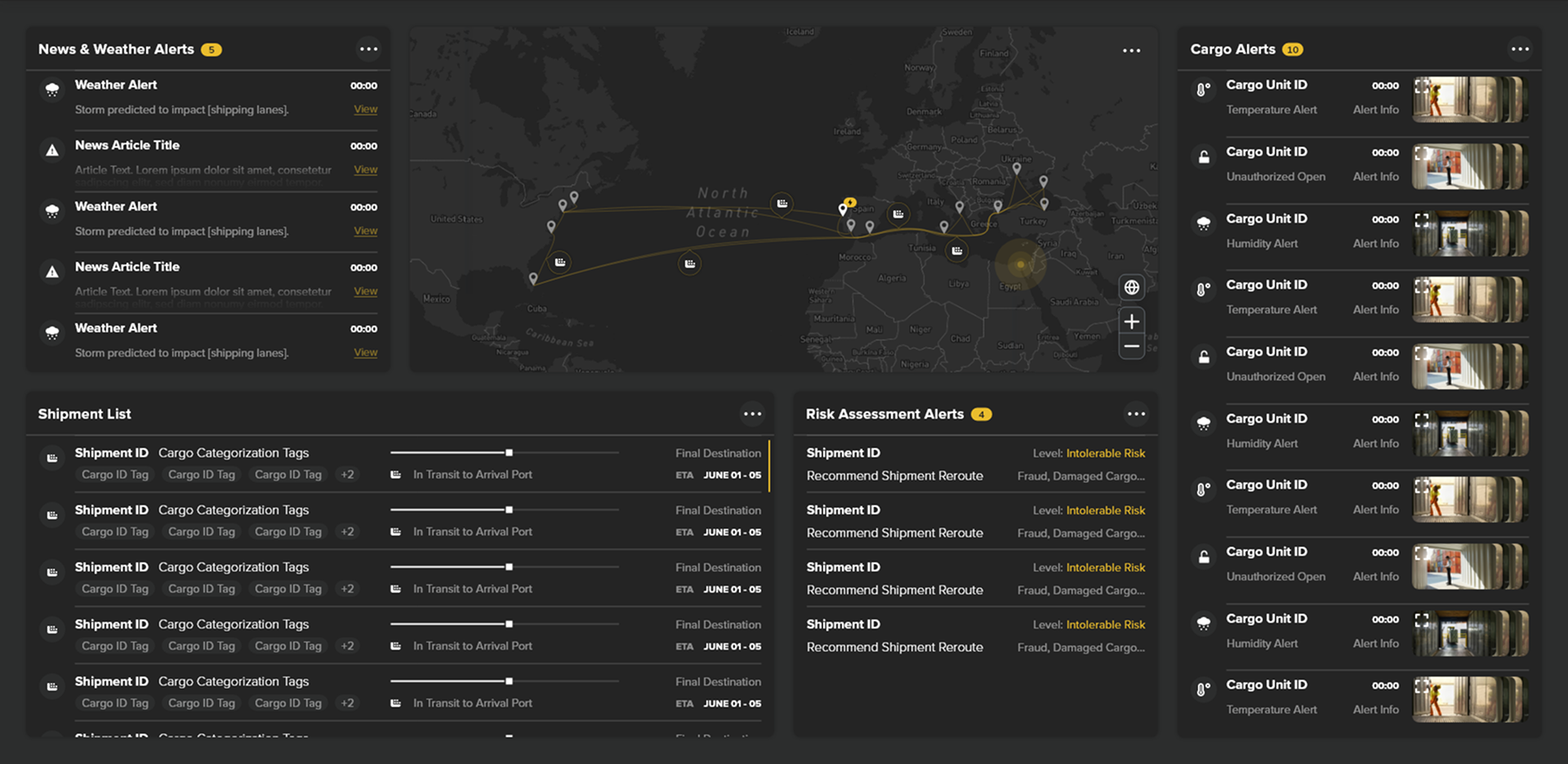
Dashboard displaying news and weather alerts, a world map with shipping routes, shipment list with IDs and tags, risk assessment alerts highlighting intolerable risk shipments, and cargo alerts with status icons and thumbnail images.
These hi-fi concept widgets, made using temporary branding, demonstrate to potential users a customizable platform that can meet their diverse needs.
An early mockup of CCargo, then known as Stargo, showing a world map with shipment location, shipment routes, and shipment destinations marked
The Shipment Map widget coalesces info on current shipments that users explore in greater detail in other widgets. Gaps in this coverage would be damage user trust.
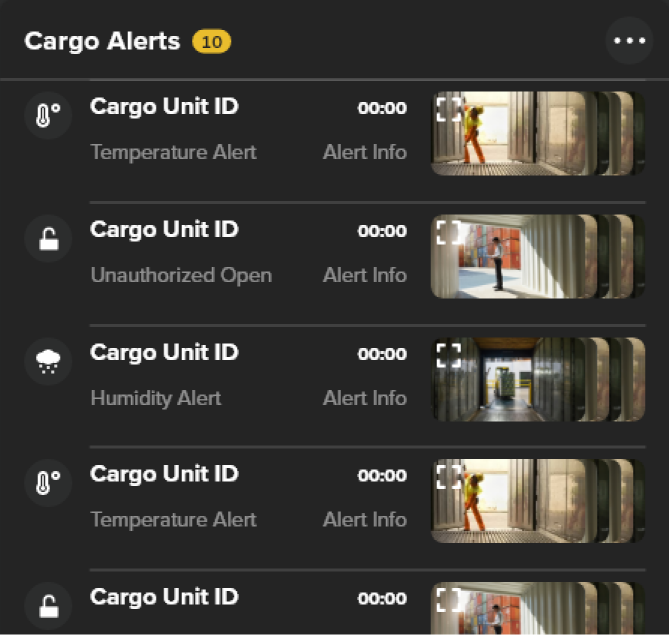
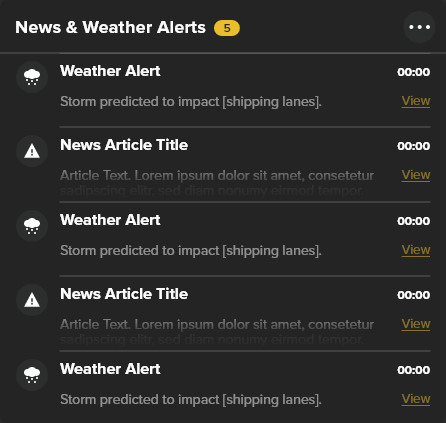
An early mockup of the Cargo alerts widget for CCargo, showing a list of alerts, with attached photos from the CCargo IoT device when the alert was triggeredAn early mockup of the News and Weather alerts widget for CCargo
Concept widget design focused around providing the user with reactive alerts tracked by the minute and provided by the hour. This insight validated the assumption that users want much more granular information.
Features
Activities
Component and Icon Library
UI Guidelines
Developer Specifications
Feature #1: Modular Widget Platform
A modular dashboard with functionally independent widgets and a plug-and-play API allow users to fully integrate CCargo data into their existing digital infrastructure and communications.
The product spec version of the CCargo dashboard, with finalized container alert, shipment list, shipment map, and communications widgets
Each widget was designed alongside developers to ensure independent functionality. This allows users to pull CCargo data into their proprietary tools or plug them in their entirety into open-source platforms with authentication.  
Feature #2: SYmbiotic Mobile App
The mobile app gives on-site workers relevant information on the cargo, while updating the shipment’s location with their phone’s data.
1 of 3 CCargo mobile app screens. This one shows a part of the process for assigning a CCargo device to a container2 of 3 CCargo mobile app screens. This one shows a the final step in assigning a CCargo device to a cargo container3 of 3 CCargo mobile app screens. This one shows a prompt for a dock worker to allow CCargo access to his location so that it can update the location of the container
Originally built to close coverage gaps in CCargo data, the CCargo mobile app reception was so positive, the team began exploring other in-field use cases such as device assignment.
Feature #3: Detailed Logs
The access logs show when a container has been opened and for how long, increasing security for the owners and accountability across the board.
A screen layout for CCargo showing a shipment's access logs
Adding the Container Information screen prompted lots of positive user feedback and suggestions for more advanced widget tools providing data analytics for BCOs, 3PLs, and FFs to review each others services.
Conclusion
Results
With the product specifications complete, API testing underway, and potential development partners waiting for word of progress, CCargo was approved to finish hardware development and launch a website. Regrettably, the entrepreneur of CCargo faced unforeseen legal challenges unrelated to the project, which required pausing development.
Lessons
The CCargo design process revealed the complexities of building a flexible system able to meet the diverse needs of each supply chain stakeholder. From logistics providers and cargo owners to warehouse workers and port officials, the challenge was maintaining a consistent product experience across a wide range of use cases.

It was vital to ensure each piece of the platform could function independently. By centering the design system around modular widgets, each with layers of information, I helped ensure that the platform met the broad range of user requirements without overwhelming the development process.